skip to main |
skip to sidebar


LQ and Gina's
2008-11-22
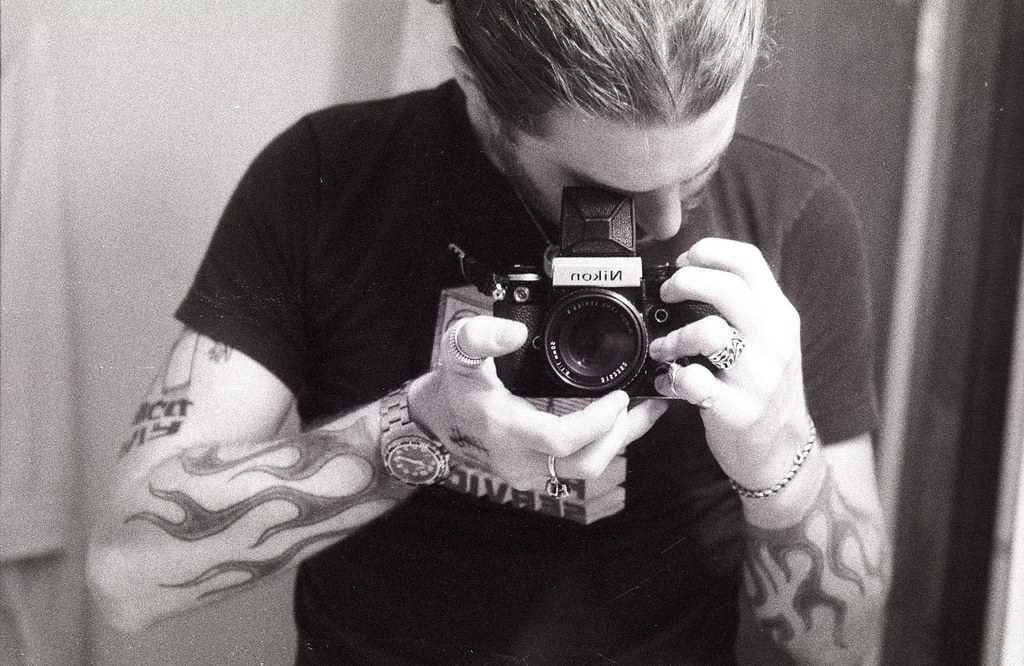
Nikon F2
Nikon Ai 16mm f/2.8 fisheye lens
Nikon Non-Ai 50mm f/1.4 lens
Ilford XP2 Super 400 35mm film
(expired) Kodak Gold 200 35mm film
Nikon SB-19 flash
Cactus V2s wireless flash triggers
I ran out of time while scanning negatives at school, so during a little bit of down time on internship, I decided to try a little idea..
I typically scan 35mm film photos on a Nikon Coolscan V ED. I wanted to see what I could do with a very basic (and somewhat halfass) light-table/copy-stand setup.
I used a small softbox under a translucent panel to act as a light table, a tripod and boom with a C-stand acted as my copy stand, and scrap matte board was used to cut down on glare/fogging.
The results are sketchy at best, due to several issues: the translucent panel was rather dirty and scratched. I did not set-up or use any kind of negative holder, so the negatives are not held flat against the panel. I set my focus and macro ratio (>1:1), but neither the C-stand nor tripod had any sort of geared rise/fall, so adjusting/repositioning the negatives was difficult. And many of the negatives themselves were poorly exposed making a less-than-ideal control/subject for this little experiment.
I made my "scans" with a Nikon D3 and Nikon AF 60mm f/2.8 macro lens. I edited the images through Adobe Photoshop CS3 and CS2. The black and white negatives cameout with a far lower contrast than desired. The C-41 processed XP2 has a red-ish purple base that becomes a cool cyan blue when inverted. I left the color in most as a style choice. The color negatives were also low contrast. And color was very hard to control. The inverted Kodak Gold 200 had a very blue cast. But the film was expired, color balanced for daylight, but shot under tungsten, and many were very under exposed. Also, I was unable to use dust cleaning, sharpening, grain and color adjustment features that come standard with Nikon Coolscan and other film scanning software.
In the end, I like the results. Because of the dust and scratches, along with the rough edges and distortion.
There was one positive result: Many of the very underexposed negative were virtually unsalvageable using the Nikon Coolscan V ED because of its automatic analog gain adjustment. Those negatives came out far better using my DIY method.
Setup shots:


 *
*